Shoulder joint의 Pain evaluation
* Who need X-ray?
1st visit, routine Hx/PE : NO
No improvement after Tx : Yes
Odd Hx or PE, History of Fx or injury : Yes
Pre-referral : Yes
Recommended XR : AP/outlet views
- History
1) Chief Complain(location, duration)
2) Onset, Motive(trauma, repetitive use, natural)
3) Rest pain, Motor pain, Night pain
4) Underlying disease, Op history
5) Age, Job
6) Other joints pain
2. Inspection
1) Shoulder and scapular movement with asymmetry, deformity, muscle tone, atrophy
2) Posture : chin-up head, round shoulder
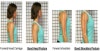
- Posterior view
① Scapula elevation : shortened trapezius upper, l. scapulae, rhomboid // weakened lower, middle trapezius
② Scapula abduction, ext rotation : shortened s. ant, trapezius, pectoralis, l. dorsi
③ Scapula adduction : rhomboid, middle trapezius
④ Scapula depression : lower trapezius
⑤ Round shoulder : shortened pectoralis
⑥ Forward drawn head : kyphotic upper thoracic spine
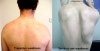
- Muscle weakness
- Range of motion
1) Flexion : 180° (Ant. Del, Coracobrachialis, Biceps, Pec major)
2) Abduction : 180° (Deltoid, Supraspinatus, Infraspinatus, Subscapularis, T. minor, Biceps long head)
3) External rotation : 90° (Infraspinatus, T. minor, Post. Deltoid)
4) Extension : 50-60° (Post. del, l. dorsi, triceps, t. major, t. minor)
5) Adduction : 75° (Pec major, l. dorsi, t. major, subscapularis)
6) Internal rotation : 70-90° (Pec major, l. dorsi, t. major, subscapularis, ant. del)
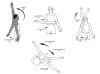
* Active shoulder motion
1) Flexion, Abduction, Internal/External rotation
2) Abduction-external rotation
3) Adduction-internal rotation
4) 상체 교차운동 하면서 통증이나 운동제한이 있는지를 확인
5) 외전시 장애 있을때 외회전 확인(외회전 제한 : 관절 문제 // 외회전 제한 X : Bursitis나 Supraspinatus)
* Passive shoulder motion
1) Glenohumeral joint의 실제 가동범위를 검사, 검사자가 관절의 움직임을 느낀다.
2) 근육이나 건과 같은 수축성 조직의 병변시 active movement 제한되나 수동운동은 가능하며 해당하는 한가지 저항운동이 통증을 유발시키게 된다.
3) 관절의 비수축성 조직(인대, 관절낭)의 병변은 수동운동시 통증과 움직임의 제한이 있게 된다.
* Painful arc
1) Acromion과 Humerus의 tubercle 사이에 병변부위가 끼게 되는 자세에 놓여질때, 이차적으로 나타나는 증상
2) 60~90º에서 나타난다.
3) Supraspinatus, Subscapularis, Infraspinatus tendintis, Subacromial bursitis
- Physical examination
1) Apley’s scratch test

2) Mouth wrap-around test
① Flexion + Abduction + External rotation
② 주동근(weakness) : Infraspinatus
③ 길항근(limitation) : Subscapularis(4+), Teres major(2+)
④ Articular capsule일 가능성도 있다.
3) Hand to shoulder blade test
① Extension + Adduction + Internal rotation
② 주동근(weakness) : Subscapularis, Teres major
③ 길항근(limitation) : Infraspinatus(3+), Teres minor(3+), supraspinatus(2+), deltoid(2+)
④ Articular capsule일 가능성도 있다.
4) Resisted movement
① 나이가 많으면 사실상 시행이 불가능
② 증상이 경미하면 체크 의미가 적다
③ 저항 검사시 통증의 발생은 근육이나 건 조직의 병변을 의미
④ 근력은 정상이고 통증만 유발된다면 cervical nerve root irritation에 의한 경우를 고려해본다.
* Empty can test
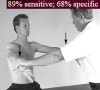
* Infraspinatus test
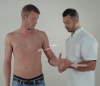
* Subscapularis test

5) Back rup test : Coracobrachialis(3+) or deltoid(2+) problem
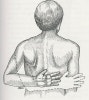
6) Horizontal adduction test
① AC joint lesions
② Subcoracoid bursitis
③ Subscapularis tendon problems
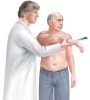
- Neurologic examination : Motor/Sensory/Reflex
6. Radiologic examination : Plain X-ray, MRI, US
- MRI
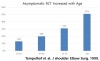
① Useful for soft tissue(Rotator cuff tear, Cartilage, Bursae)
② Identifies tendon retraction, muscle atrophy, fatty infiltration : Suggest chronic tear & poor prognosis
2) MR Arthrogram
① Main use : instability in those < 35 y/o
② Gadolinium injection enhances view of labrum
③ Typical history of shoulder instability or labral tear
3) CT
① Useful for characterzing fractures
② Consider CT arthrography in evaluation of rotator cuff in setting of previous shoulder replacement
③ Otherwise not many uses
- Causion
1) Rule out extrinsic sources
2) Radicular pain : Cervical spine
3) Referred pain
① C3, 4 : Phrenic nerve to diaphragm
② C8-T4 : Heart innervation
③ Lung : Pancoast’s tumor
이 글을 쓴 사람
김효섭 원장 · 침구의학과 전문의
금맥한의원 · 서울특별시 강서구 화곡로 176-4, 2층 (5호선 화곡역 3번 출구 바로 앞 2층)
전화 02-2696-3375 · 평일 09:00–21:00 (점심 13:00–14:00) · 토·일·공휴일 09:00–16:00 (점심시간 없음)
이 글은 일반적인 건강 정보를 다루며 개별 진료를 대신하지 않습니다. 증상과 치료 방법은 사람마다 다르므로 진찰 후 판단이 필요합니다.