발목의 관절(ankle joints)
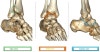
The ankle, or talocrural region, is the region where the foot and the leg meet.
The ankle includes three joints
1) Ankle joint(talocrural joint) : Dorsiflexion and plantar flexion
2) Subtalar joint : Inversion and Eversion
3) Inferior tibiofibular joint
Motion : Inversion & Eversion, Adduction & Abduction, Dorsiflexion & Plantar flexion
(Supination : Inversion, Adduction, Plantar flexion / Pronation : Eversion, Abduction, Dorsiflexion)
Stability
1) The bony architecture of ankle joint is most stable during dorsiflexion.
2) Ligamentous support is more important during plantarflexion.
1. Talocrural joint(Ankle joint proper)
1) Hinge type of synovial joint
2) The articular between tibia and talus bears more weight than between fibula and talus.
3) The articular surface of tibia is referred to as the plafond.
4) Between the inferior ends of the tibia and fibula which form a deep socket(mortise) and the trochlea of the talus.
2. Subtalar joint
1) Beneath the true ankle joint is the second part of the ankle, which consists of the talus on top and calcaneus on the bottom.
2) Allows side to side motion of the foot
3. Inferior tibio-fibular joint
1) Fibrous joint of syndesmosis type
2) Between the inferior ends of the tibia and fibula
3) Its integrity is important for the stability of the ankle joint.
4) It holds the 2 malleoli together forming a socket for the talus.
이 글을 쓴 사람
김효섭 원장 · 침구의학과 전문의
금맥한의원 · 서울특별시 강서구 화곡로 176-4, 2층 (5호선 화곡역 3번 출구 바로 앞 2층)
전화 02-2696-3375 · 평일 09:00–21:00 (점심 13:00–14:00) · 토·일·공휴일 09:00–16:00 (점심시간 없음)
이 글은 일반적인 건강 정보를 다루며 개별 진료를 대신하지 않습니다. 증상과 치료 방법은 사람마다 다르므로 진찰 후 판단이 필요합니다.